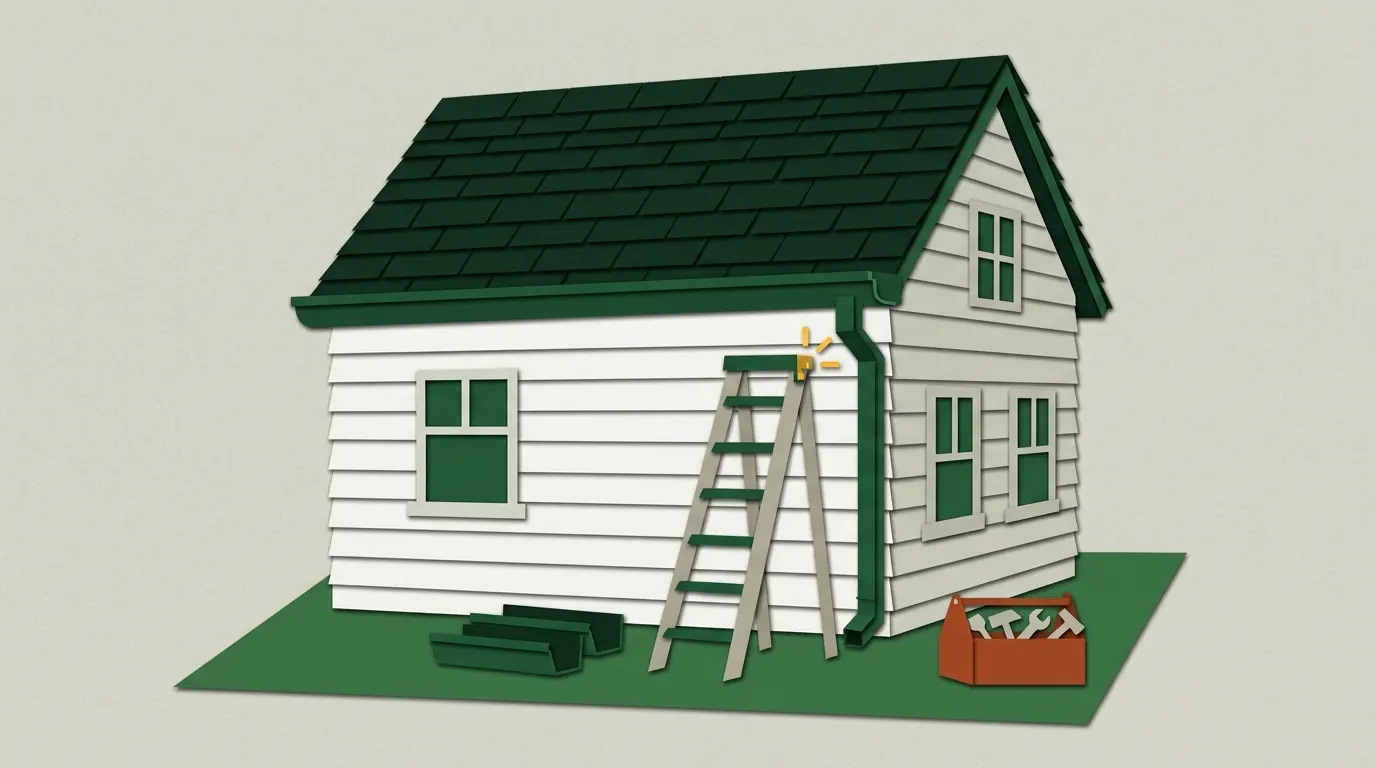
The outside of a house works as one system. The roof sheds water, the gutters catch it, the downspouts carry it away from the foundation, and the siding and paint keep the walls dry. When one part fails, the damage tends to show up somewhere else, which is why exterior jobs are worth pricing before they turn urgent.
The calculators in this category start from national prices gathered from public cost guides, then adjust them for wages and prices in your state. Each one gives you a low, typical and high price, a breakdown you can hold next to a contractor's quote, and a table of typical prices for all 50 states and DC. You don't need to leave an email to see the result.
Gutter costs
Material sets the price per foot. Installed, vinyl runs $5–$10 per linear foot, aluminum $7.55–$17, steel $8–$20 and copper $22–$40. For 150 feet with four downspouts on a one-story home, that comes to $870–$1,800 in vinyl, $1,250–$2,870 in aluminum, $1,320–$3,300 in steel and $3,350–$6,300 in copper.
Seamless gutters, formed on site so each run is one piece, come out at $6–$12 per linear foot in our data, typical $9. That's from a single source, so the figure is less certain than the others.
Three extras change the bill. A two-story home adds $1–$3 per linear foot. Each downspout runs $30–$75, a price our sources disagree on. Guards add $15–$45 per linear foot, typical $30, which is more than aluminum gutters cost. Removing old gutters runs $1–$2.19 per foot, a line the calculator doesn't include yet.
The gutter installation cost calculator covers five materials, three heights, downspouts and guards, with a separate page for seamless gutters.
Choosing a gutter material
Vinyl is the budget pick and easy to handle, which keeps labor low. Aluminum is the common middle ground and comes in many colors. Steel is heavier than aluminum and costs a little more. Copper costs the most of the five, and people usually pick it for the way it looks. For most houses the choice comes down to vinyl or aluminum; the pricier metals are a matter of taste and budget. Whatever you pick, size the downspouts and their outlets so water lands well away from the foundation.
What drives the cost of exterior work
Height and access. Almost every exterior job gets slower and pricier as the walls get taller. Ladders turn into staging, materials have to be carried up, and crews work more carefully. A steep roof or a house on a slope adds the same kind of time.
Material. Exterior materials range from budget to premium, and the gap is wide. In gutters alone, copper costs several times what vinyl does for the same length.
Labor share. About 38% of a gutter job is labor in our data, with the rest in materials. On jobs like that, local material prices matter about as much as local wages when you compare states.
What's behind the surface. Rotted fascia under old gutters or soft wood under worn paint has to be fixed before new work goes on. None of our sources price this hidden repair, which is one reason the high end of each range sits well above typical.
Tear-out and haul-away. Old gutters and other exterior materials have to come off and go somewhere. Ask whether each quote includes it, because it's easy to leave out.
Season. Exterior crews depend on the weather, so their schedules fill up in good months. If your date is flexible, ask whether timing changes the price.
How to budget an exterior project
Start with the typical number for your state, then decide which side of it you're on. Lean toward the low end if your house is one story, the roof line is simple and the crew can park close to the work. Lean toward the high end if the house is two or three stories, has many corners, dormers or roof levels, or if you're choosing a premium material.
Then add the pieces your project actually has. Guards, extra downspouts and tear-out each appear as separate lines, and guards alone can more than double a gutter bill. Running the calculator twice, once with the extras and once without, shows you what each choice costs.
Keep a cushion for what you can't see from the ground. A soft fascia board or a hidden leak often turns up only when old material comes off. I'd ask each contractor how they price that kind of repair before signing, and get the answer in writing.
Planning more than one exterior job
If a roof, gutters and siding are all due, the order matters. Roof work generally goes first, because roofers work at the edge where the gutters hang, and new gutters can get in the way or get damaged. Gutters then go up once the roof edge is finished. Siding and painting usually come after both, so drips and debris from the roof work don't land on fresh surfaces.
Asking one contractor to quote related jobs together can save a trip charge or a second set of staging, so it's worth asking even if you end up hiring separately.
Questions to ask an exterior contractor
- What exactly is included? Tear-out, haul-away, repairs to the boards behind the new material and cleanup are the lines most often left out.
- How will you protect the house and yard? Ask about ladders on siding, plants along the foundation and debris on the lawn.
- What happens if you find rot? Get the price for repairs written into the quote before work starts.
- What's the warranty? Ask about both the materials and the workmanship, and how long each lasts.
- When can you start, and how long will it take? Ask how weather delays are handled.
- Are you licensed and insured? Ask for proof of liability and workers' compensation insurance, and check licensing where your state requires it.
Reading an exterior quote
A good quote lists the job in pieces you can check. For gutters, that's the length, the material, the number of downspouts, guards or no guards, removal of the old gutters and any fascia repair. Hold each piece next to the breakdown from our calculator.
Big gaps aren't proof of a bad quote, but they're the right place to ask questions. A price far below our low number often means something is missing, such as removal, downspouts or a thinner material. A price far above the high number may reflect a tall house, a steep roof or repairs the contractor saw up close and we can't.
Before work starts
Walk around the house with the contractor and agree on where the ladders, trailer and debris will go. Point out anything fragile along the walls, from flower beds to outdoor lights. If you're in an HOA, check whether it needs to approve colors or materials. Ask where each downspout will release water, so it drains away from the foundation and not toward a neighbor's yard. Bring the ballpark. Ask for the line items.