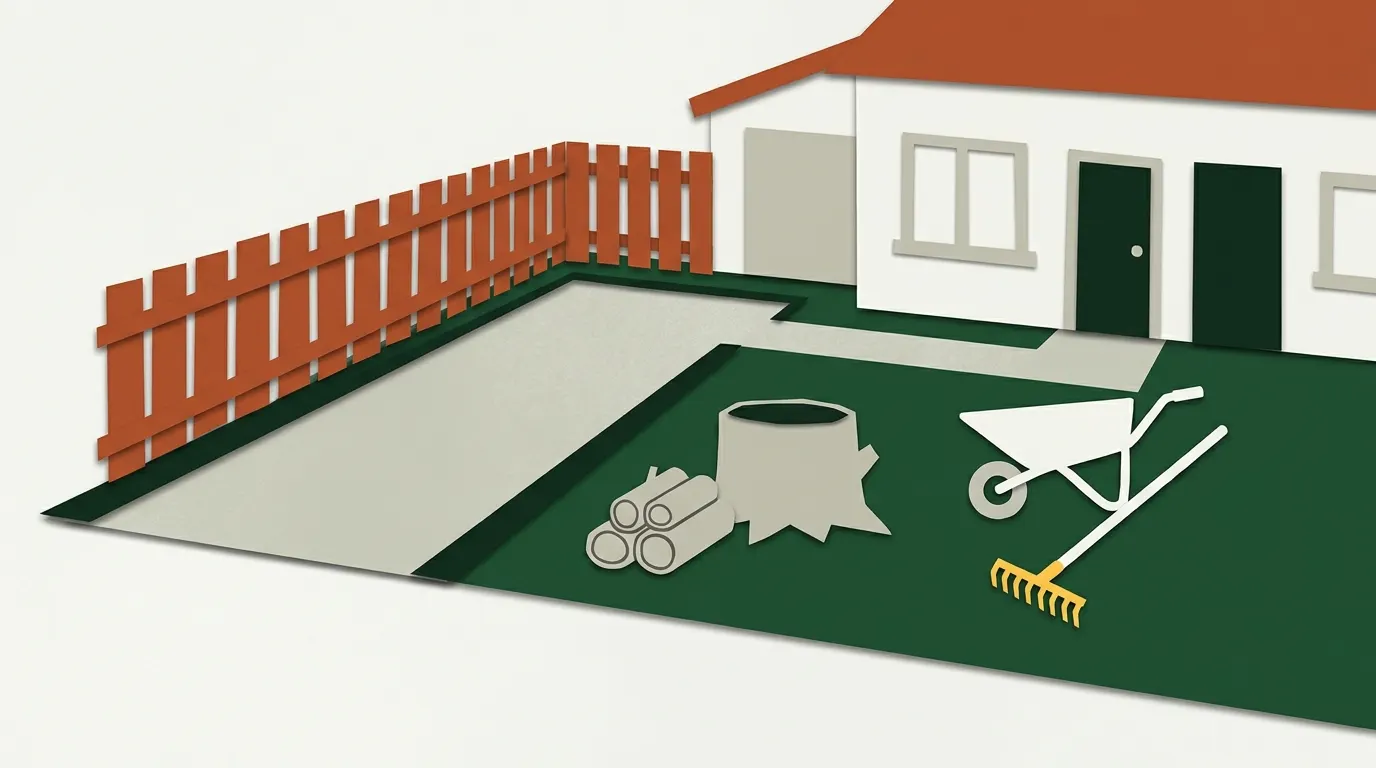
Yard and concrete jobs are where homeowners most often guess wrong, because the work hides in the ground. A fence is mostly post holes, a driveway is mostly what goes under the gravel, and a tree is mostly the climbing and cutting you don't see from the porch. The calculators in this category start from national prices gathered from public cost guides, then adjust them for wages and prices in your state.
Every calculator gives you a low, typical and high price, a breakdown you can hold next to a contractor's quote, and a table of typical prices for all 50 states and DC. You don't need to leave an email to see the result.
Tree removal costs
Height decides most of the price. In our data one tree under 30 feet costs $200–$450 to take down, a 30–60 ft tree $450–$1,040 and a tree over 80 feet $1,180–$2,000. A tree close to a house or power lines adds 25–50%, from one source. Stump grinding is a separate line: $2–$5.50 per inch of diameter, or $120–$450 per stump when the size is unknown. For a single 30–60 ft tree, adding stump grinding moves the national range to $630–$1,640. Haul-away of the wood and debris adds $70–$200 if the crew doesn't include it.
The tree removal cost calculator handles several trees at once and lets you add grinding, haul-away and the permit.
Fence costs
Material sets the price per foot. Installed, chain link runs $8–$30 per linear foot, wood privacy $18–$45, vinyl $20–$40 and aluminum $22–$50. For 150 feet of 6-ft fence with one gate, that works out to $1,330–$5,080 in chain link, $2,970–$7,160 in wood and $3,200–$6,880 in vinyl. An 8-ft fence adds about 25–35%, and tearing out the old one adds $6.50–$13 per foot.
The fence cost calculator covers five materials, three heights, gates and removal, with separate pages for chain link, wood and vinyl fences.
Gravel driveway costs
A gravel driveway is one of the cheapest ways to add parking. Installed, it runs $1.13–$3 per square foot, typical $2, for a standard 4-inch layer. A 600 sq ft driveway of crushed stone comes to $730–$1,900. Gravel type and depth change the material half of the bill: crusher run brings that same driveway down to $540–$1,410, while a 6-inch layer raises it to $890–$2,350. Our sources disagree widely on gravel prices, so the calculator flags the range as limited data.
The gravel driveway cost calculator prices three gravel types and three depths, plus delivery.
What drives the price of yard work
Labor share. How much of the bill is labor decides how much your state matters. Tree removal is about 90% labor in our data, so a crew's hourly rate is almost the whole price. Fences and gravel driveways are closer to half labor and half materials.
What's underground. Rock, roots, slopes and soft soil all add hours. None of our sources price these site conditions separately, which is why the high end of each range sits well above the typical price.
Access. A crew that can back a truck to the work finishes faster than one carrying every post, log or ton of gravel through a side gate.
Removal and haul-away. Old fences, stumps and debris are easy to leave out of a quote. Our calculators list them as separate lines so you can see what they add.
Permits. Fees are set by your city, not your state, so we show them as a national range and don't adjust them.
How to budget a yard project
Start with the typical number for your state, then decide which side of it you're on. Lean toward the low end if your yard is flat and open, the job is simple and you're flexible on timing. Lean toward the high end if the site is steep, rocky or tight, if you want premium materials, or if the old structure has to come out first.
Then add the pieces your project actually has. A stump, an old fence to tear out or a long haul for the gravel truck each shows up as its own line in our calculators, and each can move the total by a few hundred dollars or more. Running the calculator twice, once with the extras and once without, shows you what each choice costs.
Add a cushion for what you can't see. Buried rock, a larger root ball or a wet spot under the driveway can change a quote after work starts. Ask each contractor how they handle surprises like these and put the answer in writing.
When you compare quotes, line them up against the breakdown from our calculator. A quote that leaves out removal, haul-away or the permit may look cheaper than it is.
Planning more than one job
If a tree, a fence and a driveway are all on your list, the order matters. Tree work usually goes first, because falling limbs and heavy equipment can damage a new fence or a fresh gravel surface. A fence along a driveway is easier to set once the driveway's edge is marked. Asking one contractor to quote two related jobs can also save a separate trip charge, so it's worth asking.
Questions to ask a yard contractor
- What exactly is included? Removal of the old fence or stump, haul-away of debris and cleanup are the lines most often left out.
- Who handles the permit? Ask who applies, who pays and whether the price in the quote includes the fee.
- What happens if you hit rock or roots? Get the extra charge, if any, written into the quote before work starts.
- How long will the job take, and when can you start? A long wait can be a fair trade for a lower price, but know it up front.
- Are you licensed and insured? Ask for proof of insurance, and check licensing where your state requires it.
- How do you protect the lawn and the driveway? Heavy equipment leaves marks; ask how the crew will get to the work and what they'll repair.
Reading a yard work quote
A good quote lists the job in pieces you can check. For a fence, that's the length, material, height, number of gates, removal and the permit. For a tree, it's the number and height of trees, whether the stump is ground and whether the wood is hauled away. For a driveway, it's the area, the gravel type, the depth and the delivery.
Hold each piece next to the breakdown from our calculator. Big gaps aren't proof of a bad quote, but they're the right place to ask questions. A price far below our low number often means something is missing; a price far above the high number may reflect a hard site the contractor saw and we can't.
Before any digging
Fences and driveways both involve digging. Have underground utility lines marked before anyone digs; your contractor should arrange it, but confirm that in writing. Check your property line, your HOA rules and any setback your city requires for fences near a street. Bring the ballpark. Ask for the line items.