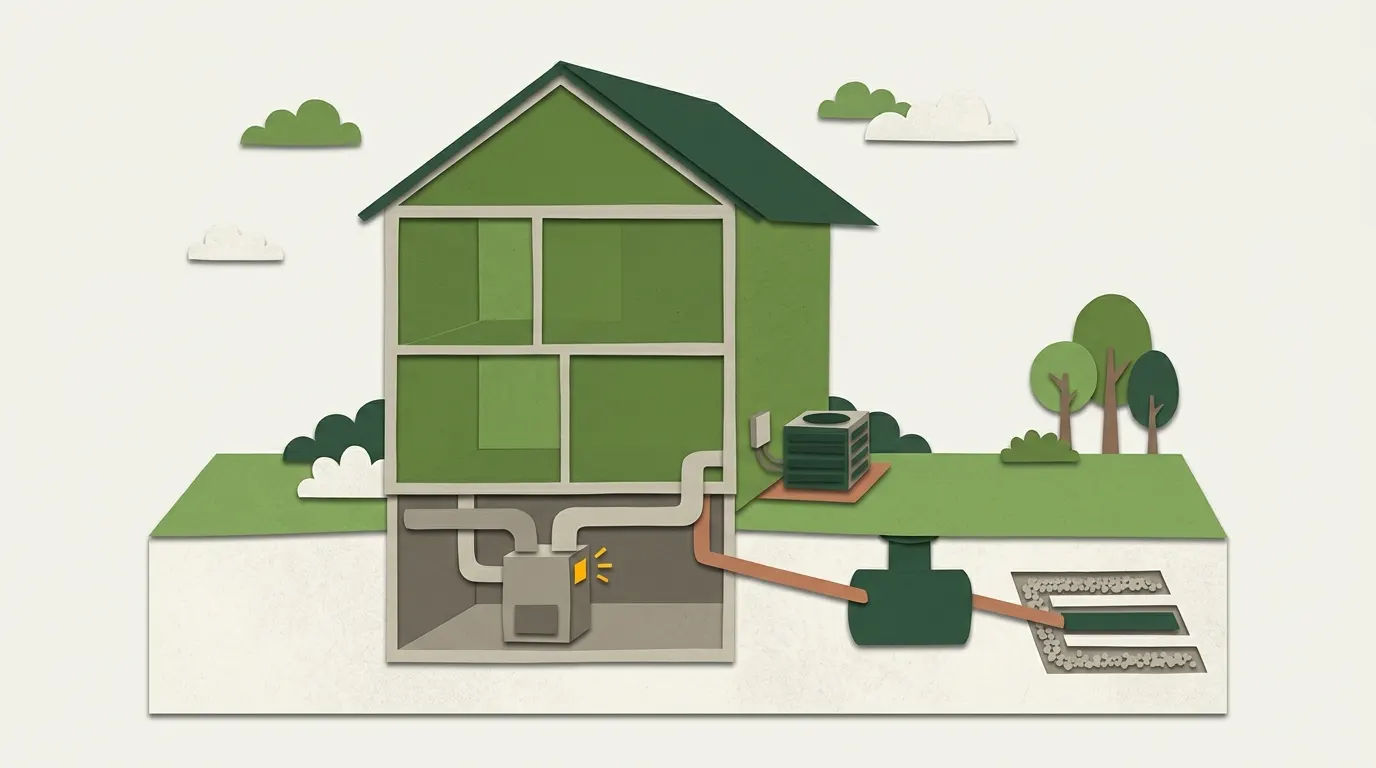
Home systems are the jobs you can't put off for long. When the furnace quits in January or the septic tank fails, you usually need quotes fast, and that's exactly when it's hard to tell a fair price from a high one. The calculators in this category start from national prices gathered from public cost guides, then adjust them for wages and prices in your state.
Each calculator gives you a low, typical and high price, a breakdown you can hold next to a contractor's quote, and a table of typical prices for all 50 states and DC. You don't need to leave an email to see the result.
HVAC replacement costs
The system you pick sets the starting price. A standard central AC for a 2,000 sq ft home runs $4,200–$12,800, typical $9,040, including removal of the old unit and the permit. A heat pump runs $5,700–$16,000, typical $9,580. A ductless mini-split runs $2,200–$11,500, typical $8,800. Replacing a furnace and AC together runs $7,450–$17,500, typical $11,100.
Efficiency and ducts add the most on top. A high-efficiency tier raises the central AC example to $5,100–$14,800, and a premium tier to $6,700–$18,800. New ductwork moves it to $6,300–$16,800. Our sources disagree on heat pump prices and on the cost of efficiency upgrades, so the calculator flags those ranges as limited data.
The HVAC replacement cost calculator covers four system types, home size, three efficiency tiers and duct work. The heat pump cost calculator starts with the system already set to heat pump.
Furnace replacement costs
Fuel sets the price first. For a 2,000 sq ft home with an 80 percent AFUE furnace (AFUE is the share of fuel that becomes heat), gas runs $3,960–$11,800, typical $7,900. Electric is the least expensive to install, at $2,160–$8,830, typical $5,500. Propane runs $3,510–$9,580, and oil $6,910–$11,800.
Efficiency is the next big choice. A 90–95 percent AFUE gas furnace raises the example to $4,710–$17,300, typical $11,000, and a unit rated 96 percent or more to $8,460–$17,800, typical $13,100. Both higher tiers include new venting, which our single source prices at $250–$1,500.
The furnace replacement cost calculator handles four fuels, seven home-size brackets and three efficiency tiers.
Septic system costs
Soil decides most of a septic bill, because it decides which system you can build. A new conventional system for a 3-bedroom home runs $3,850–$11,800, typical $6,650, with the perc test (a soil test that shows if a drain field will work) and the permit included. A chamber system runs $5,850–$15,800. Mound and aerobic systems, built for poor soil or a high water table, both run $10,900–$23,800.
Replacing only part of a system usually costs less than starting over. A tank replacement runs $3,250–$12,300, typical $6,750, and a drain field replacement $3,250–$17,300, typical $7,250. Bedroom count doesn't change the job price in our data, though it does set the tank size.
The septic tank replacement cost calculator covers new systems, tank and drain field replacement, and four system types.
What drives the price of home system work
Equipment and labor split. Heating and cooling jobs are a bit more equipment than labor: about 42.5% labor for HVAC and 40% for furnaces in our data. Septic is the other way around, at about 60% labor, because most of the work is digging. That's why your state's wages move a septic price more than a furnace price.
Efficiency choices. Higher-efficiency AC, heat pumps and furnaces cost more up front. The calculators show exactly how much each tier adds, so you can weigh it against your own utility bills.
Existing setup. A like-for-like swap is the cheapest version of every job here. Changing fuel, switching system type, adding ducts or rebuilding a drain field all add work.
Site and access. A furnace in a tight attic, an AC on a roof or a septic tank under a patio takes more hours. None of our sources price access separately, which is why the high end of each range sits well above the typical price.
Permits. Fees are set locally, and our sources disagree widely, so we show them as a national range and don't adjust them.
How to budget a home system job
Start with the typical number for your state, then decide which side of it you're on. Lean toward the low end if you're replacing like for like, the equipment is easy to reach and you can wait for a good install date. Lean toward the high end if you're changing system types, upgrading efficiency, fixing ducts or building on difficult soil.
Then add the pieces your job actually has. Venting for a high-efficiency furnace, duct repairs or a perc test each shows up as its own line in our calculators, and each can move the total by hundreds or thousands of dollars. Running a calculator twice, once with the extra and once without, shows what each choice costs.
Leave room for what nobody can see before work starts. A cracked heat exchanger, a corroded line set or a buried tank in worse shape than expected can change the plan. Ask each contractor how they handle surprises like these and put the answer in writing.
Repair or replace
Our calculators price replacements, not repairs. If a contractor recommends a full replacement, it's fair to ask what a repair would cost and how long it might last. For a septic system, an inspection can show whether only the tank, only the drain field or both have failed. For heating and cooling, ask whether one part has failed or the whole system is near the end of its life. A second opinion on a big replacement is reasonable, and a good contractor won't mind it.
Questions to ask a home systems contractor
- How did you size the system? For HVAC and furnaces, a load calculation beats matching the old unit's label.
- What exactly is included? Removal, venting, duct work, the thermostat and the permit are the lines most often left out.
- Who pulls the permit and books the inspection? Ask who pays the fee and whether the quote includes it.
- What's the warranty? Get the equipment warranty and the labor warranty in writing; they're often different.
- Are you licensed and insured? Ask for proof of insurance, and check licensing where your state requires it.
- When can you start, and how long will it take? A heating job in a cold snap or a septic job in wet weather can wait for the schedule.
Reading a home systems quote
A good quote breaks the job into pieces you can check. For HVAC, that's the system type, size, efficiency tier, duct work, removal and the permit. For a furnace, it's the fuel, the AFUE rating, the capacity, venting, removal and the permit. For septic, it's the system type, the tank, the drain field, the perc test, excavation and the permit.
Hold each piece next to the breakdown from our calculator. Big gaps aren't proof of a bad quote, but they're the right place to ask questions. A price far below our low number often means something is missing; a price far above the high number may reflect a hard site the contractor saw and we can't. Bring the ballpark. Ask for the line items.